
Main Module
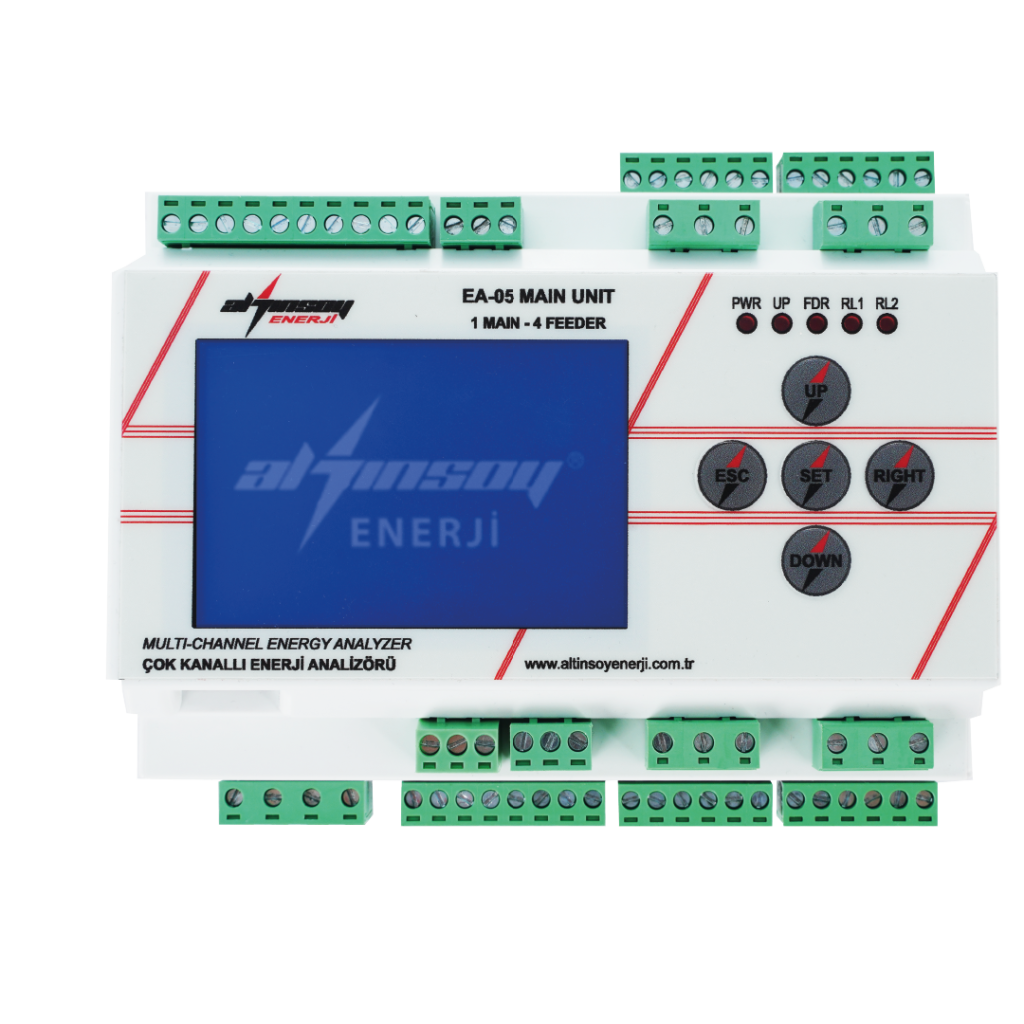
Main Module; It is designed to monitor and control smaller systems with fewer outputs that can store the energy measurements and interruption records of the main input and 4 feeder outputs. All energy measurements of the system or the facility can be monitored and controlled via a 72x54 mm LCD screen or via a remote connection. With the Feeder module, which can be added as the number of outputs increases, the energy measurements and interruption records of larger systems can be transferred to the main module, increasing its traceability and manageability.
Main Module; It has a structure that can read measurements with high sensitivity and precision from Ks/5A (600/5A, 2500/5A etc.) current transformers for measuring the main input energy and Ks/1A (160/1A, 630/1A etc.). ) current transformers for the feeders. integration has been carried out.
Main Module; The signal status, the detection delay and the detection edge information can be monitored, high and low alarm conditions can be created, and control values can be assigned with 2 digital inputs, 2 digital outputs and 1 relay contact output that can be set as active or passive on the device.
Feeder Module
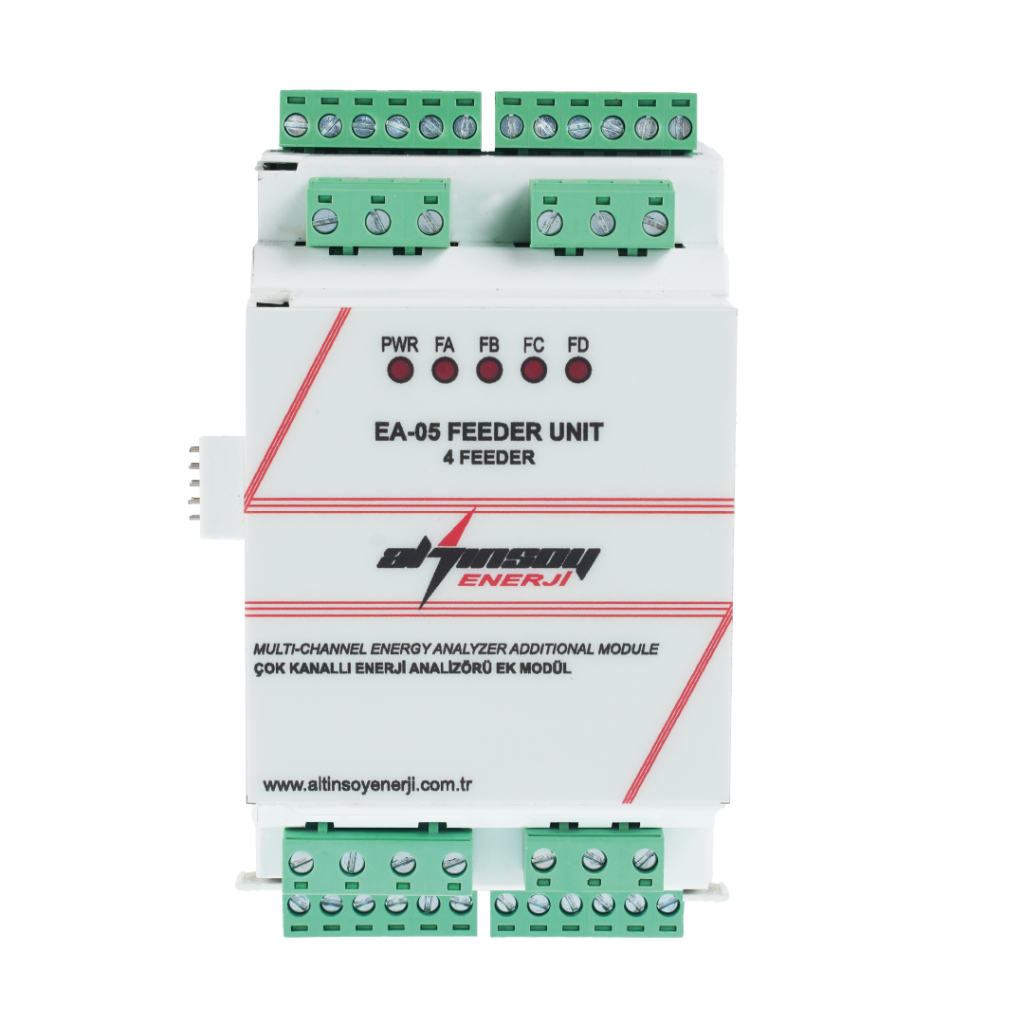
Feeder Module; It is designed in a structure that can keep the energy measurements and interruption records of 4 feeder outputs and transfer all the information to the main module, where the information can be read via the main module and remotely. It is an additional module in a modular structure that works integrated with the main module and can be multiplied by adding more than one feeder module to one another.
The feeder modules are integrated in a structure that can read measurements with high precision and accuracy from Ks/1A (160/1A, 630/1A etc.) current transformers for measuring the energy of the feeder units.

It ensures that the energy measurements and records taken with the devices used separately for the inputs and the outputs in low-voltage distribution networks can be obtained via a single device. The complete structure can be controlled and the entire system can be monitored remotely more easily. It can be controlled according to defined scenarios and alarms, and the necessary interventions in the system can be carried out with digital and relay contact outputs. The energy measurements are in a modular structure that can be multiplied according to the number of outputs required. With its high reliability in measurement accuracy, it can meet the needs of all energy systems. The Altınsoy multi-channel energy analyzer, all of whose quality tests have been completed, is ready to meet your measurement and recording needs in LV distribution networks.
Data not available in a standard single-channel analyzer:
- Power failure
- Voltage drop – rise
- Current and voltage sequence error,
- Frequency deviation
- Overvoltage – overcurrent harmonic,
- Voltage – current imbalance,
- Excessive inductive load – over capacitive load,
etc. recorded for the feeder. It can be monitored instantly from remote access points. It is easier to analyze and to intervene with visual reports.
In the current and common state of the art, the analyzer uses:
- RMS values,
-phase-neutral and phase-phase voltages,
-Neutral current, total current, phase currents,
- Power factor, instantaneous active power (V), instantaneous apparent power (VA), reactive power (VAr),
- Frequency (Hz),
-Average and maximum powers,
-Harmonic distortion,
-Active power consumed per hour (Vh),
-Inductive reactive energy (kVArh or MVArh),
-Capacitive reactive energy (kVArh or MVArh)
- It measures many parameters such as the phase angles for all channels and presents them to the user.